
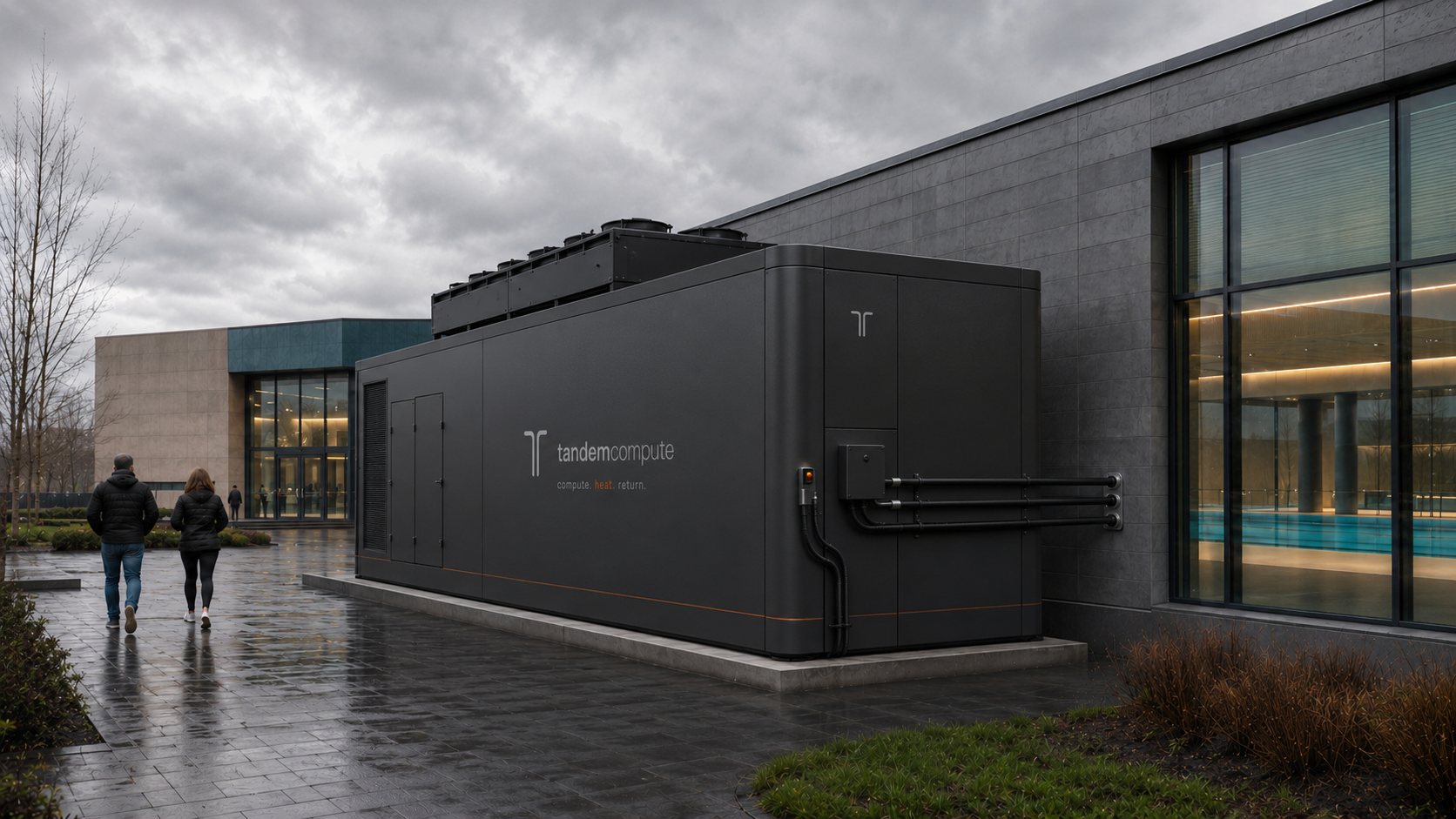
concept visual · 250 kVA pod 250 kVA external unit shown — pods can also sit in an internal plant room. Final design subject to engineering, planning, procurement and host agreement. Not an operating Tandem site.
Not your typical data center.
Massive, dedicated buildings.
Noisy air cooling, running day and night.
Heavy water consumption.
Heat rejected into the environment.
Compact: an external unit or an internal plant room.
Quiet liquid cooling.
Closed loop, minimal water.
Heat metered and returned to the host, reducing the cost to operate pools.
A new type of compute infrastructure for Ireland.
Distributed
Standardised pods across host sites of vastly different types and sizes — from a single plant room to a full campus — intended to operate as one connected fleet.
Liquid cooled
Liquid cooling is what lets the most advanced, highest-density chipsets run in a compact footprint — quiet, efficient, and with the heat captured in a recoverable loop instead of blown away.
Useful heat
Around 80% of the electricity entering the compute re-emerges as recoverable heat, designed to be returned to local operators — warming community pools, cutting hot-water costs, serving industrial processes.
Sovereign
Compute capacity owned and operated in Ireland, under Irish and EU law. Capability the country does not have to rent.
Useful heat helps Tandem fit into host sites. Compute remains the commercial engine.
Six curves are converging.
None of these is Tandem’s doing. Together they make distributed, heat-returning compute practical in Ireland for the first time.
Chip density
Each GPU generation packs more compute — and more heat — into less space. At this density, liquid cooling stops being exotic and becomes the sensible engineering answer.
Liquid cooling
Direct liquid cooling has moved from specialist to standard practice, and it is what makes heat recoverable at useful temperatures.
Nationwide fibre
Ireland’s fibre build-out now reaches towns and host sites that were never connectable at this bandwidth before. Compute no longer has to sit in a Dublin campus.
EU regulation
EU energy-efficiency rules increasingly require data centres to report the heat they reject — and favour designs that put it to use. Heat return is becoming policy, not preference.
Grid guidance
ESB and regulator guidance points away from concentrated new loads and towards distributed connections that work with local network capacity — the shape of a pod fleet.
On-site generation
Fuel-cell power — Bloom-style solid-oxide units — has matured into a practical on-site source, opening sites without a gas or heavy grid connection, common in the west of Ireland.
Ireland needs data centres. Dublin cannot take any more.
of Ireland’s installed data centre IT capacity is in the Greater Dublin Area — 1,543 MW across 36 sites.
annual GVA enabled by data centres in Ireland — and 876,000 jobs, 32% of national employment.
no new data centre connection applications in the Greater Dublin Area until at least then, per EirGrid.
annual GVA forgone in 2030 if capacity does not scale — with 94,000 jobs.
What stalls hyperscale is what opens tandem.
KPMG’s remedy — direct large loads “to strategic locations with suitable infrastructure, renewable potential, and with options for private-wire connections” — describes the tandem model.
The Value of Data Centres to Ireland — KPMG for DETE, March 2026.
How Tandem works
One loop, four stages, repeated at every host site.
A pool is one of the few places that needs heat every day of the year — water held near 29°C, showers, warm air. The pod’s 50–60°C loop feeds the pool’s heat exchangers through a metered connection, displacing fuel the operator would otherwise burn. The pool’s own boilers stay in place for resilience and peaks.
The same pattern fits hotels, industry and district schemes — anywhere with steady heat demand. Useful heat is what makes a site viable: it earns the host a reason to say yes, which opens locations and grid connections a conventional data centre could never reach. Tandem is not limited to small sites — the same design scales to far larger installations where power and heat demand allow.
Electricity in
Grid electricity powers the pod, metered at the connection.
GPU compute
The most advanced high-density chipsets run useful AI workloads in a compact, liquid-cooled enclosure.
Heat recovered and metered
Liquid cooling moves server heat into a recoverable loop — around 80% of the electricity entering the compute. Every delivered kilowatt-hour is metered.
Returned to the host
Recovered heat, delivered at 50–60°C, is designed to serve compatible host heating and hot-water circuits — pools, hotels, industry.
Compute is everything going forward.
Compute is becoming a foundational economic resource, and the token is its meter — one word is roughly one token, so token volume measures the AI economy directly. Efficiency will not absorb the demand: cheaper compute is used far more, not less.
token demand inside companies · the last few yearsFrom ~9T to ~820T tokens a month across Google’s model APIs, May 2024 to May 2026: 217M to 19B every minute.
~1T to ~13T tokens a month, January to June 2026, while ARR tripled from $100M to $300M+ in ten months.
Up from $9B at end-2025; Q2 revenue of $11.5B against $787M a year earlier.
Sources: Google I/O disclosures · Harvey / Sourcery, June 2026 · Bloomberg, August 2026.
token demand versus chip efficiency · the demand surplusUsage grows roughly fivefold a year: every efficiency gain is consumed by new demand.
Each chip generation roughly doubles the work done per watt.
More powered compute needed every single year: the gap Tandem sells into. The shortfall compounds — roughly 6.3× short after two years, 15.6× after three.
The driving force of token demand will not even be humans.
It will be the agents themselves, and machine demand never sleeps.
The crossover has already happened: agentic token usage overtook human usage on OpenRouter in February 2026 and is up roughly 14× in a year. Agents brief agents, check their own work and run around the clock, so every deployed agent compounds demand without a human in the loop. One routing service now moves ~300 trillion tokens a month, and it is one of many.
Agentic token usage overtook human usage in February 2026 and is up roughly 14× in a year on OpenRouter alone, now ~300 trillion tokens a month on one routing service among many: machine demand compounds while people sleep.
Demand for compute held in Ireland.
Regulation is turning data residency from a preference into a requirement. These are the buyers that need compute inside Irish and EU jurisdiction.
Banks, insurers and payments firms under DORA and data-residency rules
Public bodies, semi-states and agencies procuring under EU jurisdiction
Hospitals, healthtech and life sciences ahead of the European Health Data Space
Legal, accountancy and professional-services firms handling privileged client data
Universities and research groups needing burst compute without overseas egress
Irish and EU AI companies that want low latency and contractual certainty
Enterprises repatriating European workloads as the Data Act eases switching
Multinationals demonstrating EU-jurisdiction processing to their own regulators
Where the revenue comes from.
A GPU earns whenever it is busy, and the market is global: compute sold from Ireland is sold to the world. Compute is the commercial engine; heat is the second sale on electricity already paid for.
€30–50 per watt of IT load is the working industry heuristic for fully sold AI capacity, set by global demand. Fibre makes Irish pods sellable into any market, with Irish-hosted sovereignty as the premium tier rather than the boundary. Tandem plans at the floor of the range, not the ceiling. For reference, xAI’s three-year large-scale compute deal with Anthropic was priced at around $50 per watt.
Direct contract
Reserved, Irish-hosted capacity under contract: dedicated nodes or committed clusters for customers needing residency, control and predictable access. Contracted first, the dependable base.
Direct spot
On-demand GPU-hours sold directly to customers anywhere: a low-commitment route into the network that keeps utilisation high.
Inference marketplaces
Hosting models and serving routed requests on global platforms, priced per token, where worldwide token-demand growth converts most directly into revenue.
GPU marketplaces
Uncommitted capacity matched to buyers worldwide on demand, so no unit of compute sits idle merely because a direct customer is not using it.
Tandem AI services
Services sold directly to customers on Tandem’s own infrastructure: the largest share of the value the hardware produces.
Tandem is pre-trading and pre-revenue. No compute or heat contracts are in place, and no revenue figures are presented here. Pricing, contract structures and projections will be set out in the Information Memorandum.
one capability, three scales.
- No electricity generation required
- 80% of energy passed on as heat
- 12 weeks to deploy
- No planning. No rent.
Pools are ideally suited because of heat reuse. We locate on site, draw electricity, and the heat goes back into the pool. Over 350 pools in Ireland spend around €70m a year on heating — mostly gas and oil, ready to convert.
- Targeting non-constrained areas
- Grid + Bloom self-generation
- Bloom heat reuse at 350°C for industrial applications
- Clean (non-combustion) and quieter
Land in unconstrained regions, with grid capacity augmented by Bloom fuel cells — non-combustion, clean and quiet. Bloom also produces heat at 350°C, opening heat reuse to industrial hosts.
- National-scale projects
- Securing the opportunity
National-scale projects. We are in the process of securing the opportunity.
Not the typical EIIS offer.
EIIS has mostly meant familiar local sectors. Tandem’s proposal is exposure to the technology stack of the exponential age — a profile rarely available to Irish private investors under the scheme.
Hospitality, food and drink, whiskey casks and other familiar trading businesses.
AI compute infrastructure — the physical layer of the exponential technology stack.
Demand bounded by a local market, or a crowded global category like whiskey.
Demand driven by global growth in AI workloads — delivered and monetised locally.
A familiar, well-understood business model.
A new asset class for Irish private investors — compute as the engine, useful heat as the fit.
Relief often at the lower rate, where the company already trades.
Pre-trading, so a qualifying EIIS investment can attract income tax relief of up to 50% — the highest rate available under the scheme.
Subject to professional confirmation, Revenue conditions, holding periods and your own circumstances; relief is not guaranteed.
A different opportunity profile — not a promise of returns. Early-stage risks apply in full: see the risk note.
The people behind tandem.
A founding team from the Redquartz group, with three decades of building, financing and operating Irish development and hospitality projects.
Commercial deals included lettings and developments for US multinationals operating in Ireland, among them Amazon and Oracle.
Simon Kelly
co-founderCo-led Redquartz, one of Ireland’s largest developers of its era. Founder of RQTwo, an active asset manager with €70m+ of equity raised.
John Kelly
co-founderPart of the Redquartz group’s track record across Irish development, hospitality and investment — from Celtic Tiger-era delivery to today’s direct-to-investor platforms.
Asked often. Answered plainly.
More detail: privacy notice · risk notice · cookie settings
{{ faq.a }}
tandem uses essential cookies to run this page and, only with your consent, statistics and marketing cookies to measure how the page and our ads perform.